Good Morning! Read this post carefully!
The French Revolution
It broke out in France in 1789. People rose up against the injustices of absolutism and they organised a government based on the ideas of the enlightenment, such as equal rights and liberties for all citizens. These ideas were defended in two texts: the declaration of the rights of man and of the citizen and the Constitution of 1791.
 |
| Timeline of the XIX Century |
The Industrial Revolution
It started in the late 18th century in England with the steam engine invention. Steam engines burnt coal to heat huge water boils which produced steam. This steam was used to move machines like looms in textile factories as well as trains and steam boats.
Carlos IV
He was born in 1748 and died in 1819. He was very well-meaning and pious. He married Maria Luisa de Parma and had fourteen children. One of his kids was Fernando VII that later was king of Spain. Carlos IV was king of Spain from 1788 to 1808.
In 1793 France declared the war to Spain. Portugal and Spain signed a treaty of mutual protection against France.
A few months after Carlos IV turned the throne of Spain over to his son (who had thus become Fernando VII), Napoleon tricked them both into a meeting at Bayonne, France, where he forced them to jointly abdicate. Napoleon then installed his brother, Joseph Bonaparte, as the new king of Spain, and Carlos IV and his family were held captive in France. The French were exiled in 1813, however, and Carlos IV's son once again became Fernando VII of Spain, returning with his family to Spain, in 1814.
 |
| Carlos IV |
The War of independence
French emperor Napoleon Bonaparte was extending his empire across Europe.
Spanish king Carlos IV of Bourbon and his son Fernando VII were fighting amongst themselves. This allowed Napoleon to invade Spain and put his brother on the throne under the name of José I Bonaparte.
On May 2nd 1808 the people of Madrid rose up against the French invasion. That meant the beginning of the war of independence.
The birth of liberalism
The war of independence was between Spain and France, but spanish people with different political ideas were also in conflict, like in a civil war.
Other countries participated in the war, on one side or another. Great Britain, fighting against Napoleon, was fundamental to the victory of Spain in 1814.
In 1812, during the war, the Cortes of Cádiz took place. This is where the first Constitution in the history of Spain was written.
It was a liberal text. This means it defended rights and liberties for citizens against absolutism.
The return to absolutism
After the war, Fernando VII of Bourbon returned to the Spanish throne.
Despite the confidence the Spanish people had in the king, he abolished the Constitution and restored absolutism. This led to confrontations between liberals and absolutists in the following years, and this continued after the death of the monarch in 1833.
The Spanish colonies in America were not pleased with these events, and proclaimed their independence.
A war for the throne
Fernando VII changed the Law of Succession to the throne. The new law allowed his daughter Isabel, declared heir, to become queen.
When the king died, Isabel was only three years old, and her mother, queen María Cristina of Bourbon, ruled as regent. The infante Carlos, brother of Fernando VII, disagreed with the new law of succession and attempted to claim the throne.
Carlos was supported by the absolutists, known as the carlists, and the queen regent gained the support of the liberals, who were able to approve the Constitution of 1837.
The absolutists, or Carlists, rejected this situation, and fought the Isabelinos in the First Carlist War.
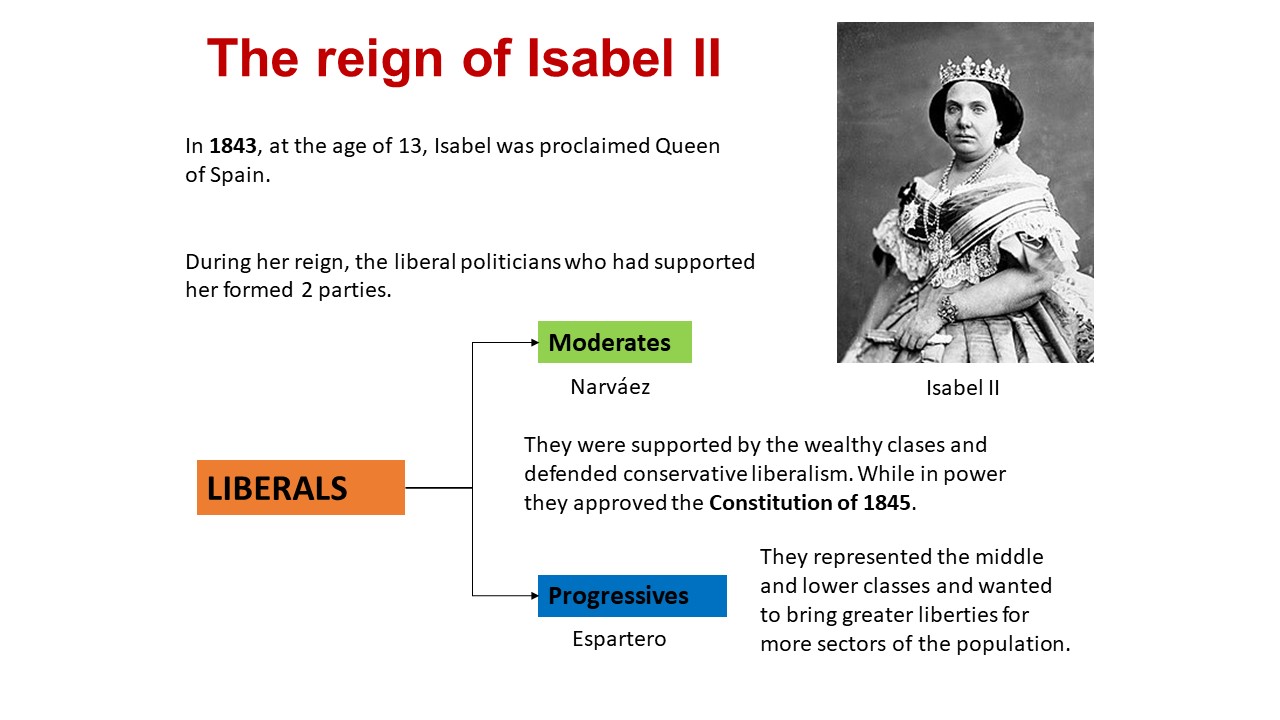
The reign of Isabel II
In 1843, at the age of only thirteen, Isabel was proclaimed Queen Isabel II.
During her reign, the liberal politicians who had supported her, formed two parties:
A) The Moderate liberals, represented by Narváez, were supported by the wealthy classes and defended conservative liberalism. While in power, they approved the Constitution of 1845.
B) The Progressives, led by Espartero, represented the middle and lower classes and wanted to bring greater liberties to more sectors of the population.
A period of democracy
The reign of Isabel II lasted until 1868. In this year a military group rose up against the queen and she went into exile in France.
The fall of Isabel II opened a democratic process in Spain. This resulted in the new Constitution of 1869, which established a parliamentary monarchy, where a monarch reigns but does not rule the country. The chosen king was Amadeo I.
The new king faced numerous problems that led him to renounce the throne in 1873.
The first Spanish Republic was then proclaimed, meaning the first government without a king. However, another military uprising restored the monarchy soon after, in 1874.
The Bourbon Restoration
A year later, Alfonso XII of Bourbon, son of Isabel II, was restored to the throne.
In this period the Constitution of 1876 was approved. This was more conservative than the one before, and a new system of government allowed alternating of the two main political parties, the Conservatives, led by Cánovas del Castillo, and the Liberals, led by Sagasta.
The restoration lasted after the death of the king in 1885. His wife, María Cristina of Habsburg, ruled as regent because her son Alfonso XIII, the heir, was still a baby. During her regency, Spain lost its last colonies: Cuba and the Philippines.