Páginas

Monday, 13 November 2023

The Interaction Function

Human beings are able to control and coordinate their activities through the interaction function. It enables living things to receive information either from the environment or from their own body through the sense organs and respond to it. 


I hope you enjoy the video!


Thursday, 2 November 2023

Excretory System

It consists of the urinary system and the sweat glands.

THE URINARY SYSTEM

The urinary system is formed by the kidneys, the ureters, the bladder, and the urethra. 

The filtered waste substances in the kidneys are mixed with water to make urine. This leaves the kidneys through the ureters and accumulates in the bladder. When the bladder is full, urine is expelled from the body through the urethra.

Excretory system

Kidneys: these are two bean-shaped organs that filter the blood and return the clean blood back to the circulatory system.

Bladder: This is a muscular cavity where urine is stored. It is shaped like a bag. 

Ureters: these are two tubes that link the kidneys to the bladder.

Urethra: this is a tube which links the bladder to the exterior. 

Kidneys

Sweat glands

When we do sport or when we get hot, we sweat. Sweat is a mixture of water and waste substances, and it is produced in the sweat glands in your skin.

Each sweat gland is formed by a large tube. The lower end of the tube acts as a filter, and at the top of the tube there is a pore that opens up to the outside. 

Sweat gland

The functions of the sweat glands are: 

a) To filter blood. They collect waste substances and water from the cells and expel them from the body as sweat.

b) To control body temperature. When it is hot, we sweat. This causes our body to cool down. 

Here is a video that you can watch:


Sunday, 29 October 2023

European Geography (Europe Unit 1)

Europe is the sixth largest continent in size and the third largest in population. It is bordered by the Mediterranean Sea to the south, Ural Mountains to the east, and the Atlantic Ocean to the West. Europe is a wealthy continent and is the center of the West and Western Democracy.


Here you have all the kahoots:

HERE YOU CAN HAVE A GENERAL REVIEW OF ALL THE EXAM: CLICK HERE

Kahoot Political Map 1: PLAY HERE

Kahoot Political Map 2: PLAY HERE

European Geography: PLAY HERE

European Mountains: PLAY HERE

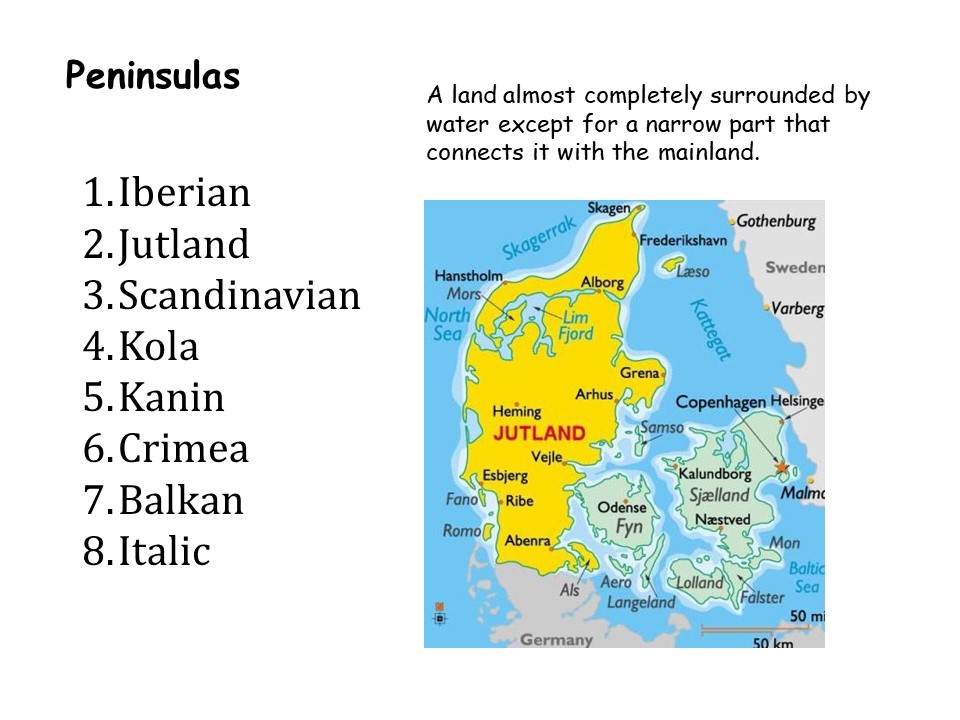
European Peninsulas: PLAY HERE

European Islands: PRACTICE HERE

Seas and Oceans: PRACTICE HERE

You can watch Europe from Google Earth

Let's now see the relief map of Europe:

Europe has been the home to a variety of civilizations including Ancient Greece and the Roman Empire. It is also the home to the birth of democracy. Europe has been the central point of two of the biggest wars in modern history: World War I and World War II. 

Recently Europe has united under a common union called the European Union. This union allows independent European countries to have a single currency and to combine their economic and military power.

We are going to study the following points:


Here you can have the definitions:

Peninsula: A piece of land almost entirely surrounded by water, connected to a larger landmass by a narrow strip.

Mountain: An elevated landform with a peak, typically rising steeply from its surroundings and generally above 700 meters in elevation.

River: A natural flowing watercourse that usually empties into a larger body of water, such as an ocean or a sea.

Island: A piece of land completely surrounded by water.

Sea: A large body of saltwater.

Ocean: The vast, continuous body of saltwater that covers most of Earth's surface.

Plain: A flat expanse of land, often part of a larger geographic region, characterized by its low relief and minimal variation in elevation.


Latitude:

Latitude is a geographical coordinate that indicates how far a specific location is from the Earth's equator, measured in degrees. It is also known as a "parallel" because lines of constant latitude form circles parallel to the equator. The equator itself is at 0 degrees latitude, and as you move north, the latitude values increase, while moving south results in decreasing latitude values. Latitude is an essential component of the global coordinate system, helping to specify a point's position in a north-south direction on the Earth's surface.

Longitude:

Longitude is a geographical coordinate that indicates the east-west position of a specific location on the Earth's surface, typically measured in degrees. It is also referred to as a "meridian." The Prime Meridian, located in Greenwich, England, serves as the starting point for measuring longitude, and it is assigned a value of 0 degrees. Locations to the east of the Prime Meridian have positive longitude values, while those to the west have negative values. Longitude is a crucial component of the global coordinate system, helping to pinpoint a point's position in an east-west direction on the Earth's surface.

Monday, 2 October 2023

Respiratory System

Through respiration we take in the oxygen our cells need to transform into energy and our body releases the carbon dioxide it doesn’t need. 

There are two processes involved in respiration: pulmonary ventilation and gas exchange.

The organs involved in the respiratory system are: mouth, nostrils, nasal cavity, farynx, windpipe or trachea, bronchi, bronchioles, alvioli, lungs and diaphragm. 


Pulmonary ventilation

Pulmonary ventilation is the movement of air into and out of the lungs. This process is performed by two movements: inspiration and expiration. 


During the inspiration movement we inhale. The diaphragm contracts, the chest cavity expands and lungs become wider and larger. 


Gas Exchange

Gas Exchange happen in the Alveoli. Alveoli are tiny air sacs in your lungs that take up the oxygen you breathe in and keep your body going. Although they're microscopic, alveoli are the workhorses of your respiratory system. You have about 480 million alveoli, located at the end of bronchial tubes.

You get Oxygen in your body and in the process of expiration you get rid of Carbon Dioxide.

An this is how the respiratory system works! You can watch these videos:


Here is a video in which I explain all the respiratory system.


And now some fun!